Mobile sports games have become more sophisticated over the past decade. Graphics have improved, online competition has expanded, and game modes have become increasingly complex. Yet one surprising trend is moving in the opposite direction: control systems are becoming simpler.
Developers are discovering that complicated touch controls often create frustration rather than engagement. While advanced players may enjoy mastering complex mechanics, many mobile users prefer experiences that are easy to learn but difficult to fully master. As a result, sports game studios are redesigning control schemes to make games more accessible without sacrificing competitive depth.
The Early Era of Complex Mobile Controls
Many early mobile sports games attempted to replicate console experiences. Developers added virtual joysticks, multiple action buttons, gesture systems, and advanced control layouts. While these features offered flexibility, they also created significant barriers for new players.
Common problems included:
| Challenge | Impact on Players |
|---|---|
| Small touch buttons | Frequent input errors |
| Complex combinations | Longer learning curves |
| Crowded interfaces | Reduced visibility |
| Device size differences | Inconsistent gameplay |
| Fast-paced action | Missed commands |
These issues became more noticeable as mobile gaming expanded beyond dedicated gaming audiences.
Accessibility Is Becoming a Bigger Priority
Modern sports games are attracting players of all ages and experience levels. Many users only play occasionally and are not interested in memorizing complicated control schemes. Developers have recognized that accessibility often leads to stronger long-term engagement.
Several recent design trends support this shift:
- One-touch actions.
- Context-sensitive controls.
- Simplified passing systems.
- Automatic positioning assistance.
- Streamlined shooting mechanics.
These features reduce frustration while allowing players to focus on strategy and decision-making.
Why Simpler Does Not Mean Less Competitive
Some players assume simplified controls reduce skill requirements. In practice, many successful sports games prove the opposite. When controls become easier to execute, competitive differences often shift toward timing, positioning, tactical choices, and game awareness.
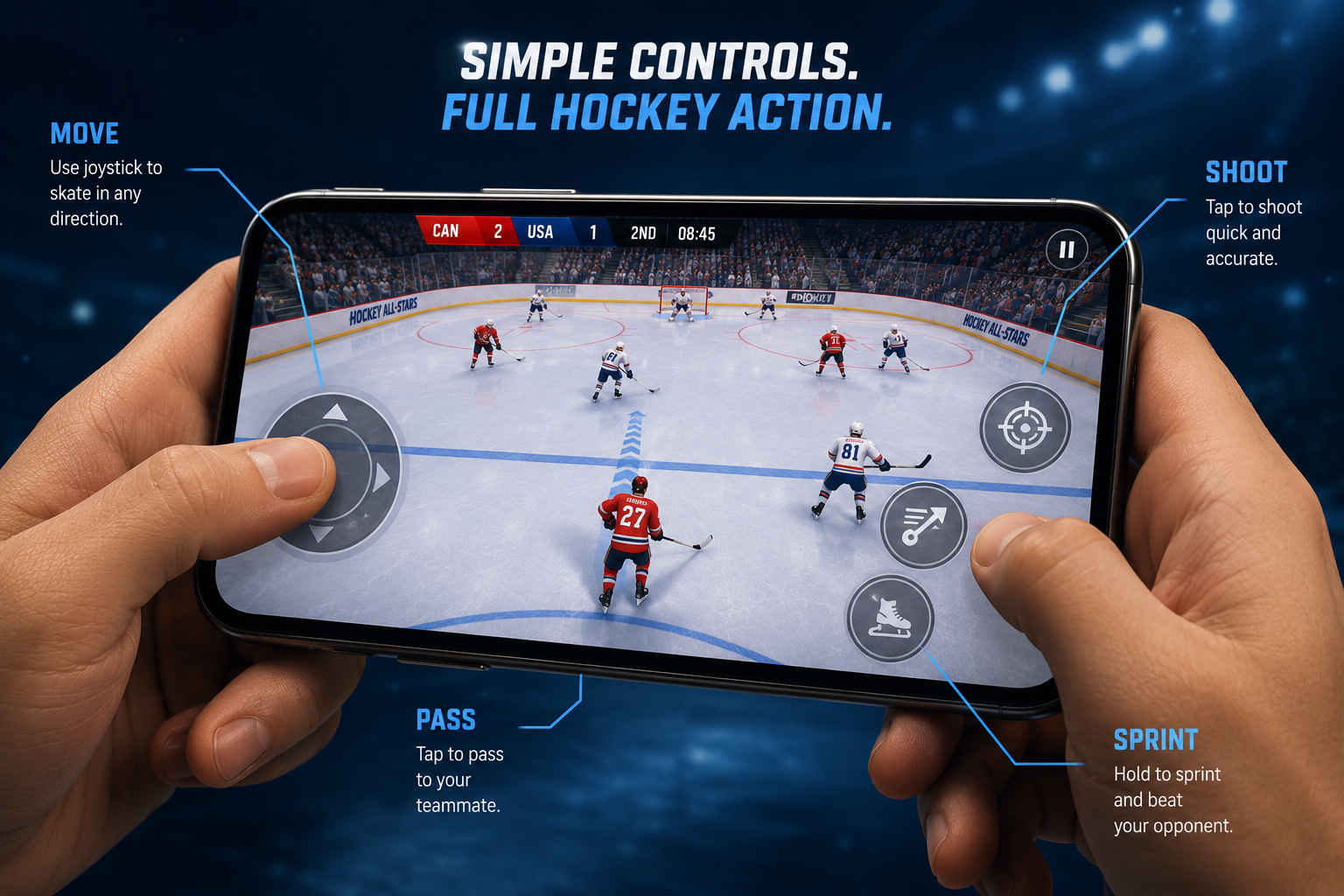
Consider hockey games. Instead of requiring multiple button combinations to shoot, pass, and defend, many modern titles simplify the physical actions and place greater emphasis on reading the game situation. This creates a competitive environment where strategic thinking becomes more important than mechanical complexity.
Touchscreen Hardware Continues To Shape Design
Unlike consoles, mobile devices vary significantly in size, screen ratio, and hardware performance. A control scheme that works perfectly on a large tablet may feel uncomfortable on a compact smartphone. Developers increasingly design interfaces around the limitations of touchscreens rather than attempting to mimic console controllers.
Key hardware considerations include:
| Hardware Factor | Design Response |
|---|---|
| Small screens | Larger touch zones |
| One-handed use | Simplified gestures |
| Foldable devices | Adaptive layouts |
| Variable refresh rates | Responsive inputs |
| Different screen ratios | Flexible UI scaling |
These adjustments help create more consistent experiences across a wide range of devices.
Hockey Games Are Benefiting From the Trend
Mobile hockey games provide a strong example of why simplified controls are becoming popular. Hockey is naturally fast-paced, with constant movement and rapid transitions between offense and defense. Complex control systems can make this speed difficult to manage on touchscreen devices.
Many newer hockey titles now emphasize:
- Swipe-based shooting.
- Automatic skating assistance.
- Simplified defensive actions.
- Contextual passing options.
- Faster match flow.
These features allow players to enjoy the excitement of hockey without struggling against the interface itself.
The Future of Mobile Sports Controls
The trend toward accessibility is unlikely to slow down. Developers continue gathering data about player behavior and often discover that simpler control systems lead to higher engagement rates and better onboarding experiences.
Future sports games may combine:
- Adaptive controls based on skill level.
- AI-assisted input interpretation.
- Personalized control layouts.
- Gesture-based actions.
- Accessibility-focused customization tools.
The goal is not to remove challenge but to remove unnecessary friction.
Conclusion
Simplified controls in mobile sports games are becoming increasingly common because they improve accessibility while preserving competitive depth. Developers are learning that successful sports games do not require complicated input systems to create engaging experiences.
As mobile hardware evolves and gaming audiences continue to expand, streamlined control systems are likely to become one of the defining characteristics of the next generation of sports games.