For decades, football video games have been dominated by familiar console and PC franchises, where realistic graphics, licensed teams, competitive modes and annual releases have shaped the market. That model is now facing a different kind of competition: games designed to reach audiences through entertainment subscriptions rather than traditional gaming platforms.
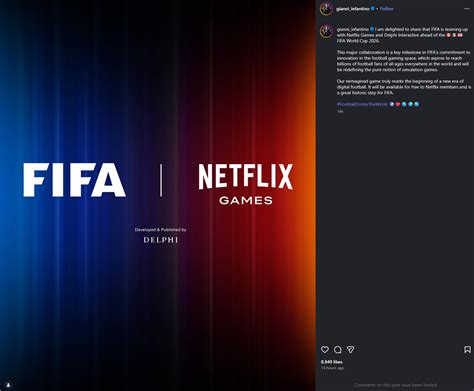
FIFA World Cup: Launch Edition, released on Netflix Games on June 11, 2026, illustrates this shift. Developed and published by Delphi Interactive in partnership with FIFA and Netflix, the title offers a streamlined football simulation built around the 2026 World Cup. Instead of requiring a dedicated console, players can launch the game on a compatible television and use their smartphones as controllers. The game is included with eligible Netflix memberships at no additional charge.
The launch represents more than another football title entering a crowded market. It demonstrates how sports organisations and entertainment platforms can approach gaming as a way to extend their existing audiences, creating a different route to market from the traditional premium-console model.
Why FIFA Is Exploring a Different Gaming Strategy
FIFA’s relationship with EA Sports ended after the two organisations failed to continue their licensing partnership under the FIFA brand. EA subsequently developed its football franchise under the EA Sports FC name, while FIFA gained greater freedom to pursue alternative gaming partnerships.
The distinction matters because a major sports licence is valuable beyond the game itself. It connects a publisher with a recognised global brand, an established fan base and the cultural attention surrounding major tournaments. However, the licence alone does not guarantee a successful product; developers must still deliver enjoyable gameplay, reliable technology and a reason for audiences to return.
The Netflix partnership represents a different approach to exploiting that recognition. Rather than immediately competing through another traditional annual console simulation, FIFA has introduced a simpler World Cup-focused experience through a service that already reaches viewers in their living rooms.
This strategy could help FIFA test a broader audience without requiring every potential player to purchase gaming hardware or a separate premium title. It also creates an opportunity for Netflix to expand its interactive entertainment offering beyond mobile games played on individual screens.
How the Netflix Football Game Works
The game’s design reflects its distribution model. Players find FIFA World Cup: Launch Edition through the Games section on a compatible television, scan a QR code using a smartphone and use the phone to control the action. The experience is intended to make it easier for several people to participate without needing a collection of conventional controllers.
According to the official FIFA announcement, the launch version includes all 48 teams participating in the 2026 tournament, 16 stadiums and more than 1,200 players. It also supports matches involving up to four people, positioning the game as a shared living-room activity rather than solely a competitive experience for dedicated football gamers.
| Feature | FIFA World Cup: Launch Edition |
|---|---|
| Distribution | Netflix Games |
| Initial release | June 11, 2026 |
| Developer and publisher | Delphi Interactive |
| Main competition | FIFA World Cup 2026 |
| Teams | 48 |
| Stadiums | 16 |
| Players | 1,248 |
| Control method | Smartphone connected to a compatible TV experience |
| Additional game purchase | Included with eligible Netflix memberships |
The simplified format is an important commercial decision. A traditional football simulation can require substantial time to learn, while a more accessible game may appeal to viewers who enjoy the sport but rarely buy video games. Whether that audience becomes a regular gaming community will depend on the quality of the experience and the updates that follow launch.
Subscription Distribution Changes the Economics
Traditional premium games generally rely on individual purchases, with additional revenue potentially coming from downloadable content, expansions or in-game transactions. Subscription-based distribution changes the initial equation because an existing member can try a game without making a separate purchase.
For Netflix, the potential benefit is stronger engagement with a subscription that already combines television, films and games. A football title tied to a globally recognised competition could encourage members to explore the gaming catalogue, spend more time using the service and view the subscription as offering value beyond video entertainment.
FIFA benefits from another form of exposure: its brand becomes accessible through a familiar service rather than depending entirely on dedicated gaming channels. This could create opportunities to connect tournament coverage, football-related entertainment and interactive experiences, although the commercial value will depend on actual audience behaviour rather than the size of the potential market alone.
The principal differences between the models are worth considering.
- Traditional premium releases: generate revenue primarily through individual game purchases, with additional commercial opportunities depending on the title.
- Subscription distribution: places the game within an existing membership, reducing the need for a separate purchase but making engagement and retention particularly important.
- Free-to-play models: typically depend on a large active audience and may generate revenue through optional purchases or advertising, depending on the product.
These approaches are not mutually exclusive, and no single model guarantees commercial success. The Netflix experiment is particularly interesting because it tests whether a familiar sports brand can attract people who might otherwise never seek out a dedicated football game.
The Challenge of Competing With Established Football Franchises
Brand recognition can help a new release attract attention, but football gaming is an established market with strong player expectations. Dedicated fans often look for detailed tactics, sophisticated controls, extensive career modes, online competition and frequent roster updates. A streamlined tournament game does not necessarily need to offer all those features, but it must provide enough depth to remain enjoyable after the initial novelty wears off.
FIFA World Cup: Launch Edition is positioned around immediate accessibility and shared play, rather than attempting to reproduce every feature associated with a full-scale football franchise. That creates a clearer target audience, but it also places greater pressure on the game to make its core matches satisfying.
Several factors will influence its longer-term prospects:
- Gameplay depth: Simple controls should make matches approachable without removing meaningful decisions from passing, shooting and defending.
- Replay value: Different teams, match situations and competitive challenges can give players reasons to return.
- Technical reliability: The connection between television and smartphone needs to be straightforward, responsive and dependable.
- Content development: Future improvements must offer meaningful additions rather than relying entirely on the World Cup licence.
- Audience reach: Regional availability, compatible devices and membership requirements will influence who can actually play.
Netflix has said the Launch Edition is intended as the beginning of a broader development process, with additional depth and features planned for subsequent updates. That makes the evolution of the game as important as its initial launch.
What This Means for the Future of Sports Games
The Netflix partnership reflects a wider opportunity for sports organisations: gaming does not have to be confined to a single hardware category or audience segment. A major tournament can support premium simulations, mobile games, casual multiplayer experiences and other interactive formats, each serving a different purpose.
For developers, this creates room to experiment with distribution and audience engagement. A game built for a living-room television may prioritise shared entertainment, while a dedicated console release can concentrate on competitive depth and detailed simulation. Both can coexist if they deliver experiences that justify their respective formats.
The approach also raises practical questions about platform dependence. A game distributed through a subscription service must account for the provider’s technical requirements, regional availability and commercial priorities. Its long-term reach can be influenced by decisions outside the developer’s direct control, making platform partnerships valuable but not without risk.
For FIFA, the immediate opportunity is to establish a recognisable gaming presence beyond its former licensing arrangement. For Netflix, the challenge is to demonstrate that sports games can contribute meaningfully to the wider subscription experience rather than serving as occasional promotional additions.
A New Route Into Football Gaming
FIFA World Cup: Launch Edition offers a useful example of how a major sporting brand can explore a different route into gaming. Its combination of a recognisable tournament, television-based play and smartphone controls lowers several barriers associated with traditional console gaming while giving Netflix another way to connect entertainment with interactive experiences.
The title does not need to replace established football simulations to justify the experiment. If it attracts casual players, encourages shared play and develops into a product people revisit after the tournament, it could demonstrate the value of a complementary gaming format.
The more important question is whether this approach can sustain interest beyond the initial excitement surrounding a World Cup. Content updates, gameplay quality, technical reliability and audience retention will determine whether the partnership becomes a lasting part of the football gaming landscape or remains a more limited tournament experience.