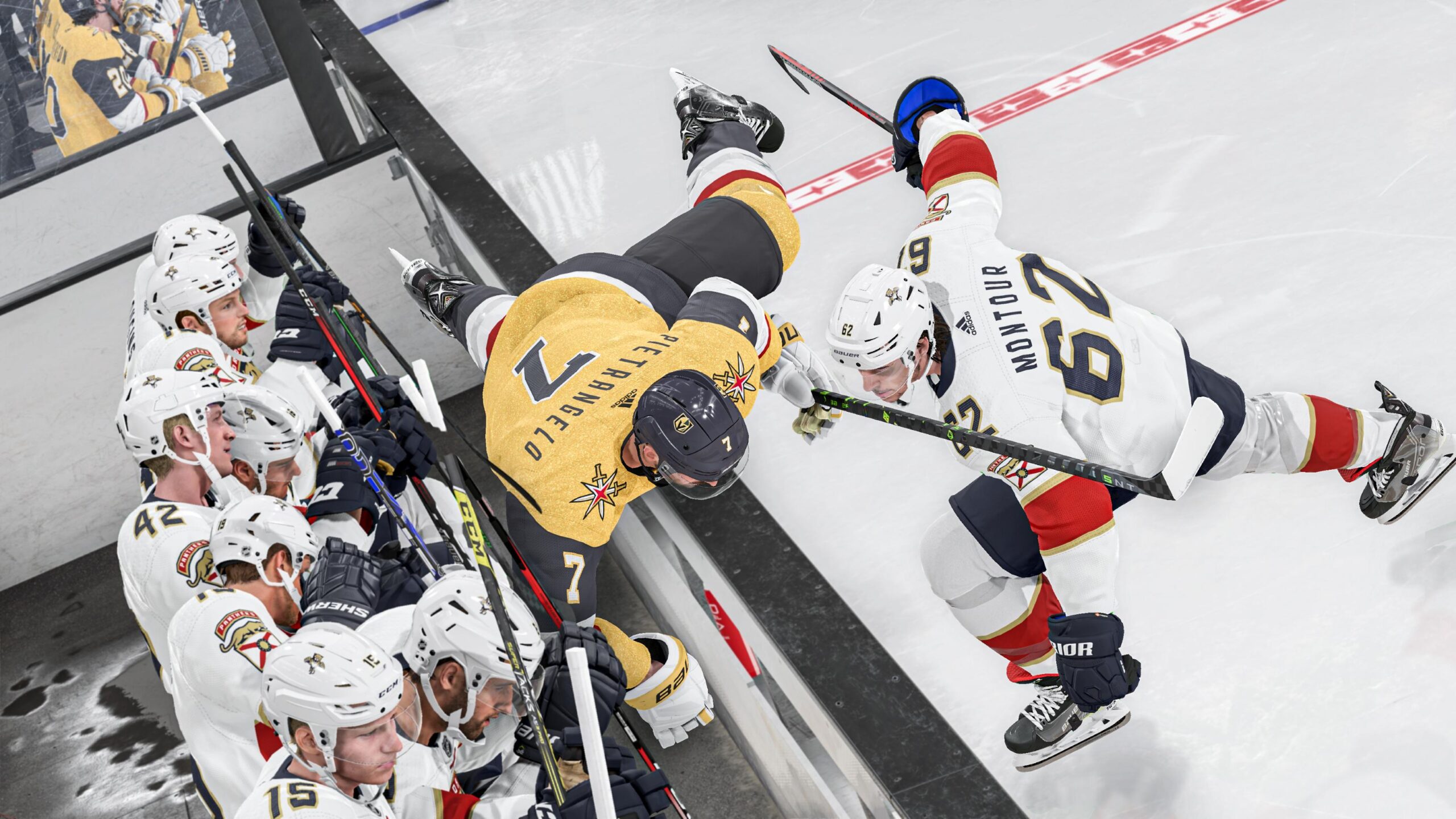

Winning the puck in the defensive zone should solve one problem, but it immediately creates another. A defender collects possession behind the net while an opponent closes from one side, a winger waits near the boards and the center begins moving through the middle. Simply skating forward may work in an arcade hockey game, yet a more tactical system asks the player to decide how the team should actually escape the zone.
That sequence is the basis of a hockey breakout. It connects defending with attacking and determines whether a recovered puck becomes a controlled rush, a difficult battle in the neutral zone or another immediate defensive problem. Mobile hockey games can use breakout systems to make this transition more meaningful without turning every possession into a complicated tactical exercise.
A defensive recovery should not automatically become an attack
Simpler hockey games often treat possession as an instant change of direction. The defending player wins the puck, turns toward the opposite goal and starts skating. Teammates quickly follow, while opponents retreat into their defensive positions.
The approach keeps matches moving, but it removes an important stage between defending and attacking. In hockey, getting possession does not necessarily mean a team has successfully escaped pressure. The puck can still be trapped near the boards, intercepted during the first pass or lost before the attacking team even reaches the neutral zone.
A deeper breakout system gives those few seconds their own purpose. Players need to recognize pressure, locate support and choose whether to move the puck quickly or wait for a safer route to develop. Suddenly, recovering possession is only the beginning of the transition.
The first pass can determine the entire rush
A breakout often starts with a relatively ordinary pass, yet that first decision can shape everything that follows. Passing directly toward a winger near the boards may provide a simple exit, while finding a center moving through open ice can create a faster transition. Sending the puck into a crowded area, meanwhile, may return possession to the opponent almost immediately.
Mobile controls are well suited to this kind of decision because the game does not need several new buttons to represent it. The existing passing system can become more meaningful when teammate positioning and defensive pressure influence which option is safest.
A player who constantly chooses the nearest teammate may still move the puck, but not necessarily move the team forward. Better breakout design rewards players who look beyond the first available pass and recognize where space is developing.
Teammates need to create useful exit routes
Breakouts depend heavily on players who do not have the puck. Once possession changes, teammates need to react quickly enough to provide options rather than simply skating toward the attacking zone together.
A winger can move toward the boards to offer a short pass. A center can drop lower into the zone to support the puck carrier before accelerating through the middle. Another skater may stretch farther forward and force defenders to decide whether to follow or maintain their position.
These movements make the defensive zone feel less static because the entire team reacts to the recovery. More importantly, they give the user several readable choices instead of forcing one predetermined exit path.
The challenge for developers is keeping those routes predictable enough to learn. If teammates move randomly every time possession changes, users cannot build any understanding of the system. Consistent patterns allow players to recognize what their teammates are trying to do while still leaving room for different outcomes.
Pressure should change the safest breakout option
The same breakout should not work against every opponent. A team applying aggressive pressure near the goal line creates different problems from one waiting closer to the neutral zone. If mobile hockey games represent that difference clearly, exiting the defensive zone becomes a small tactical puzzle rather than a repeated passing sequence.
Against heavy pressure, short support passes may be useful because carrying the puck for too long gives opponents time to close the available space. When defenders back away, the puck carrier may have enough room to skate forward before making the first pass.
This relationship can create several distinct situations:
| Defensive pressure | Possible breakout response | Main risk |
|---|---|---|
| Heavy pressure behind the net | Short support pass | Turnover near goal |
| Pressure along the boards | Pass through the middle | Interception in central ice |
| Opponents backing away | Controlled carry | Skating into a trap |
| Middle lane crowded | Wide outlet pass | Receiver pinned near boards |
| Aggressive line pressure | Quick pass behind pressure | Poor timing creates turnover |
The goal is not to make players memorize formations. It is to make pressure visible enough that they can adjust naturally.
Board play becomes more useful during zone exits
The boards are often treated as boundaries in simplified sports games, but hockey uses them as part of normal puck movement. Breakout mechanics provide a natural reason to make board interactions more useful.
A player under pressure may move the puck along the boards rather than attempt a dangerous pass through the middle. A winger can collect it farther up the ice, or the puck can continue into an area where another teammate has a better chance of reaching it. The route is less direct, but sometimes that is exactly why it works.
For a mobile game, these options can add variety without demanding precise manual controls. Players do not necessarily need to calculate complicated bank-pass angles. Consistent puck behavior and sensible teammate movement can make the boards feel like a genuine part of the playing surface rather than scenery surrounding it.
Controlled exits and emergency clears should feel different
Not every defensive possession needs to produce a clean passing sequence. Sometimes the best decision is simply to move the puck away from danger. A good hockey game should make that choice feel different from a controlled breakout.
A controlled exit keeps possession as the priority. Players look for teammates, maintain spacing and try to enter the next zone with enough structure to continue attacking. An emergency clear sacrifices some of that control in exchange for immediate relief from pressure.
Both options have value depending on the situation. If the player’s team is exhausted or trapped near its own net, attempting an ambitious central pass may create more danger than opportunity. Clearing the puck can reset the situation even if the team has to fight for possession again. That trade-off adds useful decision-making because the fastest route toward the attacking zone is not automatically the best one.
Breakouts give different player roles more purpose
Position-specific attributes become more interesting when players have responsibilities beyond shooting and defending. A defenseman with strong puck control can be valuable because they remain composed under pressure and start attacks cleanly. A fast winger can create separation along the boards, while a center with good awareness can provide a reliable option through the middle.
These differences do not need to appear as complicated statistics during every match. Players can feel them through behavior. One defender may turn away from pressure smoothly and find an outlet, while another is more effective when moving the puck quickly rather than carrying it.
That creates another layer of roster identity. Two players with similar overall ratings can contribute differently because one fits a possession-based breakout while another works better in a faster, more direct system.
Neutral-zone play begins before the puck reaches neutral ice
It is tempting to think of defensive, neutral and offensive zones as separate parts of gameplay. In reality, decisions made deep inside the defensive zone often determine what happens several seconds later.
A clean first pass can allow teammates to enter the neutral zone with speed. A slow or awkward exit may force them to stop near the blue line, giving opponents time to organize. A turnover can prevent the transition entirely and create another attacking opportunity for the other team.
This connection is valuable for mobile hockey games because it makes individual actions feel less isolated. The quality of an attack no longer depends only on what happens near the opponent’s goal. It can begin with a small positional decision made behind the player’s own net.
Camera behavior can help players see the next pass
Breakouts create a practical problem on small screens: the useful passing option may be outside the immediate camera view. If the user cannot see where teammates are moving, tactical passing becomes guesswork.
Camera systems can respond by revealing slightly more ice when possession is recovered or by shifting the framing toward the direction of the developing breakout. Small teammate indicators can also show that an outlet option exists beyond the visible area without covering the screen with tactical graphics.
The information needs to arrive early enough to influence the decision. Showing a winger only after the puck carrier has already reached the boards does not help much. Good visual design allows the user to anticipate the route rather than react after it has disappeared.
Failed breakouts can create believable scoring chances
One reason breakout systems add tension is that mistakes happen in dangerous areas. Losing the puck while attacking usually gives the opponent possession somewhere farther from the player’s goal. Losing it during a defensive-zone exit can produce an immediate scoring opportunity.
That makes pressure meaningful without artificially increasing opponent speed or shooting accuracy. The danger comes from the location of the mistake itself. A risky pass through the middle can be intercepted close to the net, while a failed board exit can keep the defending team trapped in its own zone.
Players gradually learn which mistakes are expensive. Instead of the game explaining every tactical principle through tutorials, the consequences teach them why certain passing routes require more caution.
Breakouts can make forechecking more meaningful too
Forechecking becomes much more interesting when the team in possession has several realistic ways to escape it. If every defensive recovery automatically sends the puck forward, aggressive pressure has little tactical purpose. Once breakouts require decisions, forechecking can actively influence those decisions.
An opponent pressing one side of the ice may remove the easiest outlet and force the puck carrier toward another route. A second forechecker can pressure the next receiver, while a more conservative opponent may allow the first pass but attempt to stop progress closer to the blue line.
This creates a useful interaction between two systems. Forechecking is no longer simply an attempt to steal the puck, and breakout play is no longer simply an attempt to make a pass. Each side is trying to influence where the next phase of play will happen.
Touch controls need tactical depth without extra complexity
A realistic hockey breakout can involve detailed formations and coordinated movements from all five skaters, but reproducing every option manually would be uncomfortable on a phone. Mobile games need to compress the idea rather than copy every tactical instruction.
Much of the complexity can sit behind teammate behavior. The user controls the puck carrier and chooses among several understandable routes while AI-controlled teammates provide appropriate support. Different tactical settings could influence how aggressively those teammates move forward without requiring the player to position everyone individually.
A simple system might offer a few broad approaches:
- Safe breakout: teammates stay closer and provide shorter passing options.
- Balanced breakout: one player supports the puck while others begin moving forward.
- Fast breakout: forwards stretch the ice earlier and look for longer outlet passes.
Three readable approaches can produce meaningful variety without filling the interface with formation diagrams.
Good breakout AI should respond to mistakes
Scripted movement works until the expected pass fails. A defender may hesitate, the puck may rebound unexpectedly or an opponent may block the planned route. If teammates continue following their original paths regardless, the breakout immediately looks artificial.
Responsive AI should recognize that the situation has changed. A center can return toward the puck when the defender becomes trapped, while a winger can abandon an aggressive run if the passing lane disappears. These small corrections make teammates feel connected to the actual possession rather than to a prewritten animation sequence.
The same principle applies after a turnover. Players who were beginning an attack need to recognize the lost puck and react defensively instead of continuing up the ice. Smoothly switching between these states can make transitions feel much more natural.
Better breakouts can improve match rhythm
Adding tactical depth does not necessarily mean slowing hockey down. A well-designed breakout can actually make fast attacks feel faster because the speed has been created through a successful sequence rather than granted automatically after possession changes.
A clean recovery followed by two quick passes can suddenly send a winger into open ice. Because the player had to recognize the route and execute it correctly, the resulting rush feels earned. The contrast also matters: after spending several seconds trapped under pressure, escaping into space creates a noticeable change in match tempo.
That rhythm is difficult to achieve when every possession follows the same pattern. If teams immediately accelerate toward the opposite goal after every turnover, fast play stops feeling fast because there is nothing slower to compare it with.
Breakout systems connect the whole rink
Many mobile hockey mechanics naturally focus on obvious moments such as shots, saves, checks and goals. Breakouts occupy the space between those highlights, but that is precisely what makes them useful. They explain how a team moves from surviving pressure near its own net to creating an attack at the other end.
A strong system does not need dozens of formations or complicated coaching menus. It needs teammates who provide sensible options, opponents who can disrupt those options and enough consistency for players to understand why one exit succeeds while another fails.
When those pieces work together, the defensive zone stops being somewhere players simply want to leave as quickly as possible. It becomes the starting point of the next attack, and a successful rush can feel like the result of several connected decisions rather than an automatic reward for winning the puck.