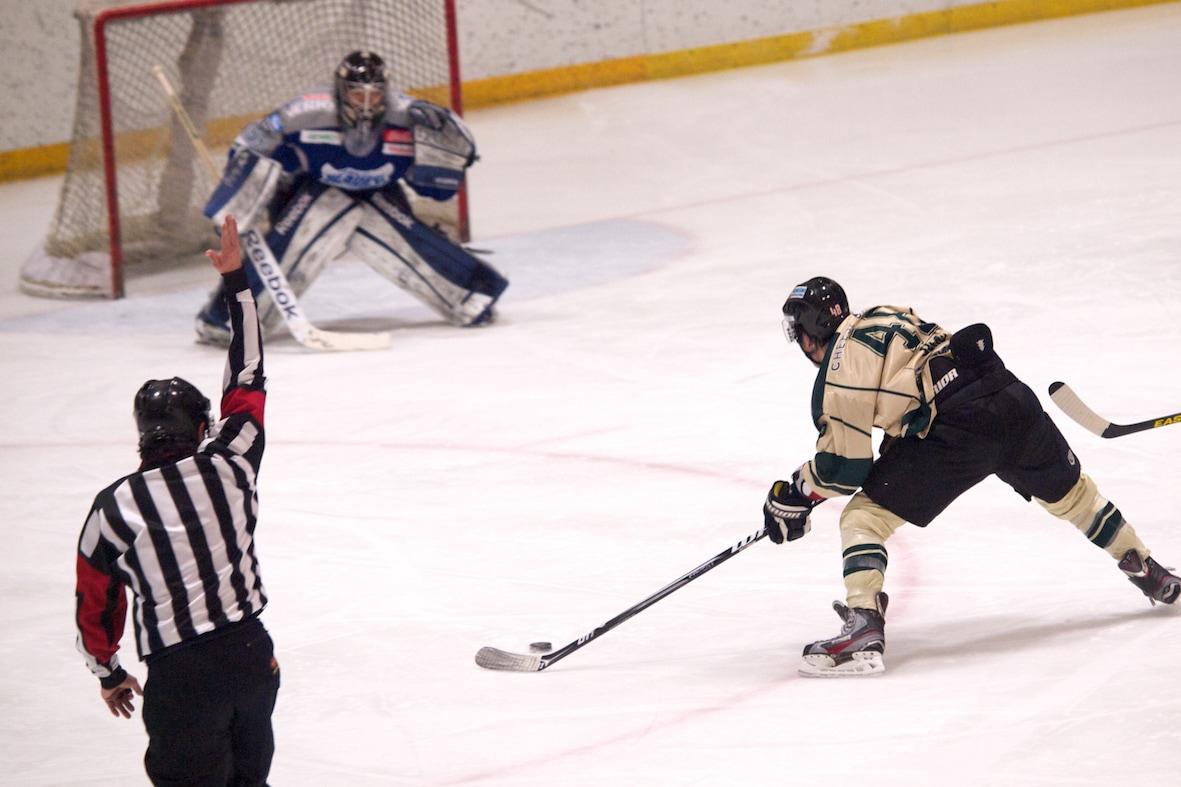
A penalty in hockey does not always stop play immediately. When a player commits an infraction but the opposing team still controls the puck, the referee can signal a delayed penalty and allow the possession to continue. The whistle comes when the offending team gains control, which creates a short period where maintaining the puck becomes particularly valuable.
For mobile hockey games, this rule can produce a distinctive tactical situation without introducing complicated new controls. The attacking team has an incentive to protect possession, move the puck carefully and use the temporary advantage rather than forcing the first available shot. If the game also supports pulling the goalkeeper for an extra attacker during the delay, an ordinary possession can suddenly become one of the most unusual attacking situations in the match.
A Delayed Penalty Changes the Value of Possession
During normal play, losing the puck is usually a straightforward problem: the other team can immediately begin an attack. During a delayed penalty, the consequences are different. Once the offending team gains control, play is stopped and the penalty is enforced, so the attacking side has an unusual opportunity to continue its possession with limited risk of an immediate counterattack.
That changes how players can think about the puck. A rushed shot may end the sequence quickly, while an additional pass could create a better opportunity before the whistle. Instead of treating every possession as a direct race toward the goal, the game can encourage players to recognize that the current situation has different rules.
This is useful in mobile hockey because tactical variety does not always require another game mode or a larger set of buttons. Sometimes changing the meaning of an existing action is enough. Passing and puck protection remain familiar, but the reason for using them changes.
The Extra Attacker Creates an Unusual Formation
One of the most recognizable features of a delayed penalty is the possibility of replacing the goalkeeper with another skater. Because play will normally stop when the offending team gains possession, the attacking side can temporarily accept an empty net and add another player to the offensive setup.
This produces a six-on-five situation before the actual power play begins. The extra skater can create another passing option, occupy space near the net or force defenders to cover a wider area. Even without complex tactical controls, good teammate AI can make the difference visible by moving players into useful positions.
The formation also looks different from normal even-strength hockey. There is more offensive support in the zone, but the attacking team still needs to maintain possession to keep the sequence alive. That combination gives the delayed penalty its own identity rather than making it feel like an ordinary power play that simply started early.
Players Need to Recognize What Is Happening
Delayed penalties can become confusing if the game does not communicate them clearly. A player may wonder why the referee has raised an arm, why the goalkeeper suddenly leaves the ice or why the whistle sounds immediately after the opponent touches the puck.
Mobile screens make this particularly important because there is less room for subtle information. A clear referee animation can help, but games may also use a small delayed-penalty indicator or another unobtrusive visual signal. The goal is not to fill the screen with explanations; it is to make the temporary rule state understandable.
Audio can support the same purpose. Commentary, crowd reaction or a short interface cue can tell the player that something unusual has happened while attention remains focused on the puck.
| Game signal | What it can communicate |
|---|---|
| Referee’s raised arm | A penalty has been called but play continues |
| Delayed penalty icon | Confirms the temporary game state |
| Goalie leaving the net | An extra attacker is entering |
| Whistle after possession changes | The delayed call is now being enforced |
| Penalty notification | Explains the infraction after play stops |
When these signals work together, the player can understand the sequence without needing to know every rule in advance.
The Best Shot May Not Be the First Shot
A delayed penalty creates an interesting attacking decision because possession has temporary value beyond simply controlling the puck. Players can use that time to circulate the puck and wait for defenders to move out of position.
This does not mean every delayed penalty should become a long passing sequence. If a clear scoring opportunity appears, taking the shot still makes sense. The important difference is that the player has a reason to consider whether the current chance is good enough.
A weak attempt from distance may end the advantage if the goalkeeper freezes the puck. A controlled pass across the offensive zone could instead create a more dangerous angle. This makes shot selection interact naturally with possession without requiring the game to introduce another shooting mechanic. The result is a short tactical puzzle: how much can the attacking team create before the whistle ends the sequence?
Defensive AI Has a Different Problem to Solve
Delayed penalties are not only interesting for the attacking side. Defenders also need to respond differently when their team is about to be penalized. Chasing the puck too aggressively can leave more open space for the additional attacker. Remaining too passive can allow the offense to move the puck comfortably around the zone. Defensive AI therefore needs to protect dangerous areas while recognizing that simply touching or controlling the puck will stop play.
This can produce a more compact defensive shape around the slot and net. Players may attempt to block passing lanes and prevent close-range opportunities rather than immediately trying to launch a counterattack that cannot continue.
For mobile games, these behaviors do not need to reproduce every detail of professional hockey strategy. They only need to make the temporary numerical difference visible enough that the situation feels distinct from standard play.
Delayed Penalties Can Connect Several Existing Systems
One reason this rule is useful for game design is that it brings several mechanics together. Puck possession matters because losing control ends the sequence. Passing becomes important because the attacking team has time to search for space. Off-puck movement matters because an additional skater needs somewhere useful to go, while defensive positioning determines whether the numerical advantage actually creates an opening.
None of those mechanics needs to be redesigned specifically for a delayed penalty. The situation simply changes how they interact. That makes the rule particularly suitable for games that already contain deeper hockey systems. Instead of adding another isolated feature, delayed penalties can reveal whether passing, teammate movement, defensive AI and possession mechanics work together convincingly.
The Transition Into a Power Play Should Feel Clear
If the attacking team does not score during the delayed call, the sequence eventually ends and the actual penalty begins. That transition should be easy to understand.
The whistle provides the first boundary. The game can then identify the penalized player and briefly show the length or type of penalty before resetting for the next faceoff. Once play resumes, the temporary six-on-five situation is replaced by the normal power-play structure.
This distinction matters because the two situations have different logic. During the delayed call, the attacking side is trying to extend possession before the whistle. During the power play, the penalty has already been enforced and the match continues with one team officially short-handed. Treating these phases separately helps players understand why the number of skaters and the risk around possession have changed.
Scoring During the Delay Creates a Memorable Exception
One of the more satisfying outcomes occurs when the attacking team converts the delayed possession into a goal. Instead of waiting for the power play to begin, the team uses the temporary advantage immediately.
In a mobile game, these moments can feel rewarding because the player has recognized an unusual situation and taken advantage of it. The sequence may involve an extra pass, movement from the sixth attacker and a shot from space that would not normally exist at even strength.
The game does not need to turn this into a special cinematic event. The rule itself provides enough context. A goal scored during a delayed penalty feels different because the opportunity existed only for a brief period and depended on keeping possession alive.
A Small Rule Can Add a Distinct Phase of Play
Delayed penalties occupy only a short portion of most hockey matches, but that is part of what makes them useful. They interrupt the normal rhythm without requiring a separate mode, arena or control system. For a few seconds, possession becomes safer, an additional attacker can enter the play and both teams have to respond to a temporary set of conditions.
The mechanic also rewards awareness. Players who recognize the referee’s signal can avoid wasting possession and make better use of the extra attacker. Those who simply continue playing as if nothing has changed may still succeed, but they miss an opportunity created by the rules.
For mobile hockey games trying to add depth without overwhelming touchscreen players, this type of situational mechanic is valuable. The controls remain familiar while the meaning of the moment changes. A raised referee’s arm, an empty goal and one extra skater can be enough to create a phase of play that feels noticeably different from everything around it.