Buying a sports game used to mean learning the rules of a finished system. A pass that worked in September would probably behave the same way in January, an aggressive defensive strategy could remain effective for months, and the quirks discovered during the first week often became part of the game for the rest of its life. That model is disappearing. Modern sports games increasingly arrive as systems that continue to be adjusted after millions of real matches expose patterns developers could never reproduce during internal testing.
NHL 27 is providing a particularly clear example. EA’s October 6 Update 2.1 follows a much larger September update and continues a sequence of post-launch fixes affecting Hockey Ultimate Team, presentation and stability. On their own, some changes look minor. Taken together with earlier adjustments to penalties, CPU decision-making and online play, however, they show how quickly a modern hockey game can evolve once players begin testing its systems at scale. The result is a different relationship between developers and players. Launch day still matters, but it is no longer necessarily the point when the way a sports game plays becomes fixed.
A Million Matches Find Problems Faster Than a Test Lab
Sports games are unusually difficult to balance because players do not simply follow the intended strategies. They search for whatever works. If one type of hit produces an advantage, competitive players repeat it. If defenders react poorly to a particular entry, someone will build an entire attacking pattern around that weakness. A mechanic that appears balanced during development can behave very differently once thousands of players experiment with it every night.
That is why post-launch information is so valuable. Developers can see situations that occur repeatedly across an enormous number of games while community reports provide context for why those situations feel wrong. Neither source is perfect on its own. Data can reveal an unusual pattern without explaining the frustration behind it, while player complaints can make a rare problem appear universal.
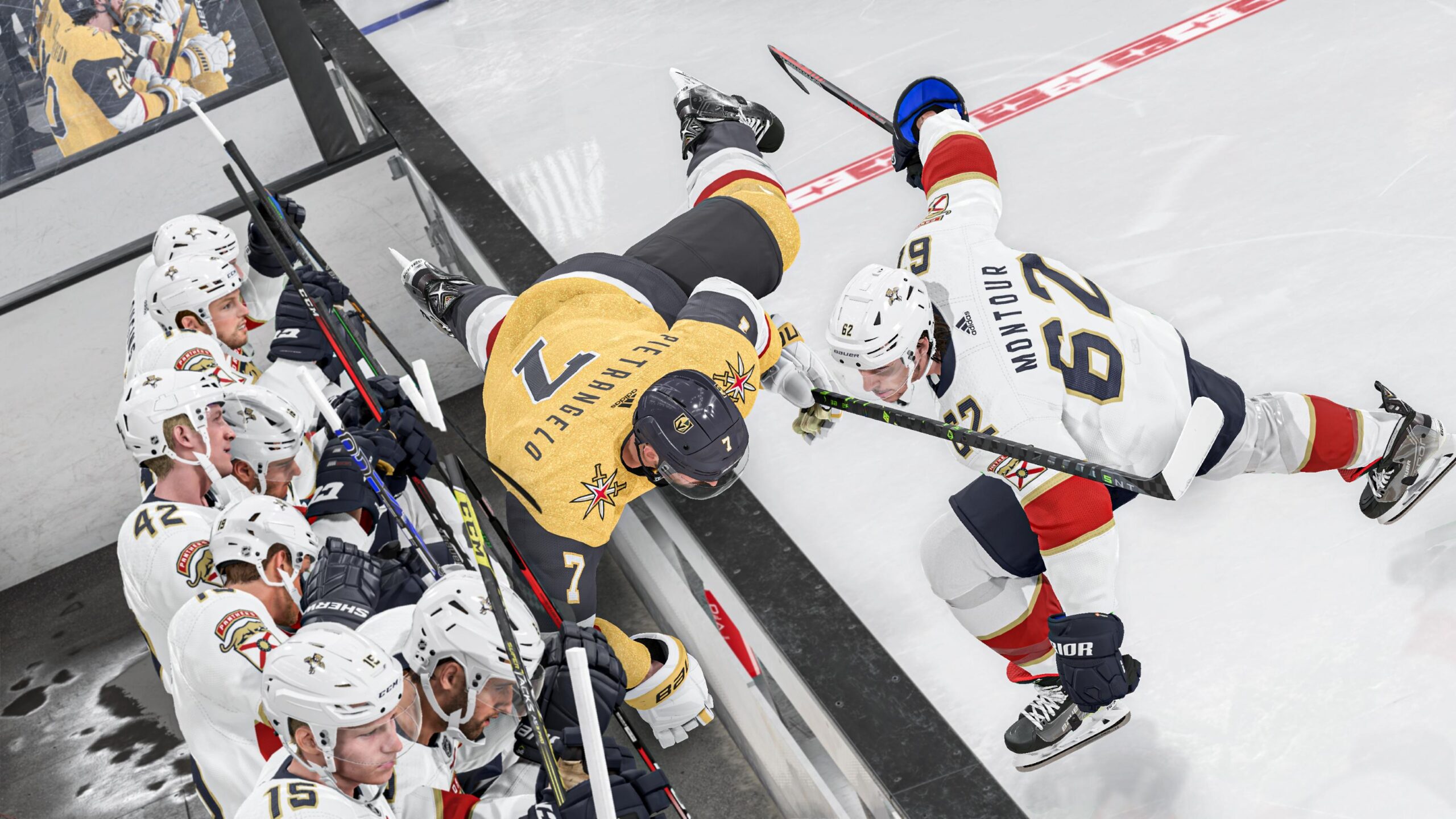
NHL 27’s first updates illustrate the process. EA adjusted CPU forwards so they would retain possession instead of dumping the puck unnecessarily when space was available, changed defensive positioning during penalty-kill breakouts and later tuned how Boarding and Charging penalties were called. These are not simply menu corrections. Each one can change the decisions a player makes during an actual shift.
Small Changes Can Alter an Entire Hockey Game
A hockey simulation is a collection of interconnected systems, so a seemingly narrow adjustment rarely stays narrow. Consider physical-contact penalties. If Boarding or Charging is called too aggressively, players may become reluctant to finish checks near the boards. If the threshold is too generous, heavy hitting can become a low-risk defensive shortcut.
Changing the penalty logic therefore affects more than the number of visits to the box. It can alter forechecking, puck protection, defensive pressure and even which player builds are attractive online. The same principle applies to AI possession decisions. A CPU winger choosing to carry the puck rather than immediately dumping it changes how a breakout develops and where human-controlled defenders need to position themselves.
| Live adjustment | Immediate effect | Wider gameplay consequence |
|---|---|---|
| Penalty tuning | Changes when hits are penalised | Alters defensive risk and physical play |
| CPU possession logic | Reduces unnecessary dumps | Changes transition and forechecking patterns |
| Defensive positioning | Improves AI location on the ice | Affects passing lanes and breakout options |
| Online desync fixes | Keeps matches synchronised | Makes competitive results more reliable |
| Stability fixes | Reduces crashes and soft locks | Protects progression and longer sessions |
This is why judging an update only by the length of its patch notes can be misleading. One carefully targeted gameplay change may influence more matches than dozens of cosmetic fixes.
Online Hockey Makes Reliability Part of Gameplay
Not every important improvement changes skating, shooting or checking. For an online sports game, technical reliability is effectively another gameplay mechanic.
Imagine a close match entering its final minutes. The score is tied, both teams have adjusted their strategies and one mistake could decide the result. If the session desynchronises after a penalty sequence, the quality of the hockey simulation suddenly becomes irrelevant. The match has failed at a more fundamental level.
Recent NHL 27 updates have addressed desync scenarios, crashes and problems across several online modes. Update 2 included a fix for a possible World of Chel desync following a penalty sequence and another involving HUT Wildcard after a missed penalty shot. It also targeted crashes across World of Chel and Hockey Ultimate Team.
These fixes may be less exciting than a new deke or shooting animation, but they directly affect whether competitive play can be trusted. As sports games become more connected, stability, matchmaking and server performance increasingly belong in the same conversation as physics and AI.
Player Feedback Is Becoming Part of Development
EA has repeatedly directed NHL 27 players toward its Feedback Portal and says community input is used to identify issues and prioritise improvements. That creates a more formal feedback loop than the old model of developers occasionally reading forum threads after release.
The advantage is obvious. Players who spend hundreds of hours with a game will discover unusual combinations of mechanics, strategies and edge cases. Competitive communities are particularly effective at finding systems that can be exploited because winning gives them a reason to test every boundary.
Useful feedback can include:
- situations where a penalty appears inconsistent;
- AI behaviour that repeatedly produces unrealistic decisions;
- strategies that become disproportionately effective;
- matchmaking conditions that create poor games;
- crashes or desyncs tied to repeatable sequences;
- and interface problems that interrupt normal play.
The difficult part is deciding which complaints represent actual systemic problems. A player losing repeatedly to the same strategy does not automatically mean the strategy is broken. Developers have to separate frustration from evidence, then determine whether a change improves the overall game rather than satisfying the loudest section of the community. That balancing act is becoming a core part of maintaining annual sports titles.
The Risk of Fixing a Game Too Often
Continuous updates solve problems, but they can also create a new one: players need a reasonably stable game to master. Competitive sports games depend on learning. Players build timing for passes, understand how defenders react and develop instincts about which actions are safe in particular situations. If fundamental behaviour changes too frequently, some of that knowledge becomes temporary.
This is especially noticeable when an update affects a popular tactic. One group may see the change as an overdue fix while another feels that weeks of practice have suddenly been devalued. Both reactions can be understandable.
The best live tuning therefore tends to target clear problems rather than constantly rewriting the underlying game. Fixing a desync is straightforward because nobody benefits from a broken connection. Correcting obviously faulty AI behaviour is similarly easy to justify. Changing the effectiveness of a legitimate strategy requires much more care because it affects the competitive balance players have already learned.
Good live-service design is not about changing the game every week. It is about knowing which problems deserve intervention and which should be allowed to become part of the game’s natural strategic development.
Sports Games Are Becoming Seasonal Products
Annual releases still define the sports gaming business, but individual titles increasingly behave like live seasonal platforms during the year between launches. Rosters change, uniforms and arena details are updated, online events rotate and gameplay continues to receive adjustments.
NHL 27’s update history already demonstrates several layers of this process. One patch can address AI behaviour and gameplay, another can focus heavily on stability and penalties, while a smaller follow-up cleans up specific problems that appeared after the previous release. Development effectively continues in public.
That changes how players should approach a new sports game. Early strategies may not remain dominant. A frustrating behaviour at launch may eventually be corrected, while a previously overlooked mechanic can become more important after another system is adjusted. Learning the game increasingly means learning how it changes.
For developers, the benefit is the ability to correct mistakes without waiting for next year’s release. For players, the trade-off is accepting that the game purchased in September may not behave exactly the same several months later.
A Better Hockey Game May Be Built After Release
There is an important distinction between using updates to repair an unfinished product and using them to improve a complex simulation after it encounters real-world play. Sports games can fall into either category, and players are right to question serious problems that should have been caught before launch. At the same time, no development team can reproduce every strategy that a large online community will discover.
Hockey makes that challenge particularly visible. Positioning, physical contact, puck possession, penalties and human decision-making constantly interact, so changing one element can produce consequences elsewhere on the ice. Live updates give developers an opportunity to observe those consequences and respond instead of locking the original balance in place for an entire year.
NHL 27’s latest patches show what that process looks like in practice. The most meaningful update is not necessarily the one with the longest feature list. Sometimes a change to a penalty threshold, an AI decision or an online synchronization problem does more to improve a sports game than a headline feature.
The modern hockey game is therefore no longer completely defined on release day. Launch establishes the rules, but millions of matches reveal how those rules actually work. What happens next depends on whether developers can turn that information into careful changes without making the ice feel different every time players return.